
Indian benchmark indices Sensex and Nifty ended flat on Tuesday, with the Sensex dipping nearly 70 points, as investor sentiment turned cautious ahead of crucial global central bank policy meetings and a significant sell-off in Asian markets.

India's banking system liquidity surplus has significantly narrowed due to tax outflows, including GST payments, and higher cash reserve ratio balances. This tightening liquidity has pushed the weighted average call rate closer to the RBI's marginal standing facility rate, with market participants anticipating a persistent deficit in the coming months.

The Supreme Court has upheld the Bombay High Court's decision to quash the Yes Bank administrator's write-off of Rs 8,415 crore worth of Additional Tier 1 (AT-1) bonds, criticising the RBI and Yes Bank's conduct.

BRICS finance ministers and central bank governors have called for increased representation of emerging-market and developing economies in the IMF and World Bank, while also criticising unilateral tariffs and trade measures, as the expanded bloc aims to bolster financial cooperation amidst global fragmentation.

The Indian rupee has achieved its longest winning streak in nearly eight years, appreciating for eight consecutive sessions to close at a six-week high. This rally is attributed to strategic central bank interventions, healthy foreign capital inflows linked to the Jio Platforms IPO, and profit-taking in the US dollar.

His remarks come amid a debate over whether Tata Sons, the holding company of India's largest conglomerate Tata group, is required to go public.

Growth in India's currency in circulation (CiC) has reached a five-year high, primarily due to deposits under the Foreign Currency Non-Resident (Bank), or FCNR(B), scheme, leading to a robust increase in reserve money, according to the Reserve Bank of India's (RBI) 'State of the Economy' report.

Reserve Bank of India (RBI) Governor Sanjay Malhotra stated that surplus liquidity in the banking system is expected to drain within the current financial year, utilising tools like currency leakage, sell-buy swaps, open market operations (OMOs), and variable rate operations.

The Central Bureau of Investigation (CBI) has dismantled a multi-state impersonation and cheating network involved in banking recruitment. Four individuals, including a CGST inspector, were arrested for allegedly infiltrating banking exams and interviews by posing as candidates, thereby compromising the integrity of public examinations.

The Reserve Bank of India's recent measures, including a dedicated dollar window for state-run oil marketing companies and tightened foreign exchange derivative rules, are expected to provide near-term relief to the rupee's depreciation, but market participants believe global factors and balance of payment dynamics will continue to exert pressure in the medium term.

India's foreign exchange reserves saw a decline of USD 5.011 billion, reaching USD 721.016 billion for the week ending October 16, as reported by the Reserve Bank of India. This marks a continued downward trend from their all-time high in September.

'We see a lot of cases of bank deposits getting lost, especially when people die, so this will help address that because you have one consolidated view.'

A special CBI court in Mumbai has ordered the issuance of proclamation against billionaire jeweller Jatin Mehta, his wife, and another individual in a Rs 146.35 crore bank fraud case involving Canara Bank. The court allowed the CBI's plea to secure the presence of the absconding accused but declined the immediate attachment of their properties, citing lack of material evidence. The accused are reportedly residing in the United Kingdom.

RBI Governor Sanjay Malhotra reiterated India's cautious stance on cryptocurrencies due to concerns over monetary sovereignty and capital flows, while actively promoting underlying technologies like distributed ledger technology and tokenisation. He also addressed the global rise in public debt and hardening bond yields, attributing it to increased government and private spending, including that driven by AI, and noted the implications of global interest rates on India's monetary policy.

Reserve Bank of India Governor Sanjay Malhotra has stated that the rupee may be 'undervalued' by many estimates and assured that the RBI will work to ensure its stability and help it find its 'correct value' amidst recent depreciation.

A two-day weekend would help employees recover physically and mentally. They would return better prepared for branch work that demands patience, judgment, and accuracy, asserts Tamal Bandyopadhyay.

Bankers said the impact could become more visible from September 29 as customers could withdraw larger amounts of cash, although ATM operations are increasingly managed through third-party cash-loading arrangements.
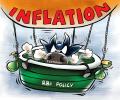
The Reserve Bank of India (RBI) has marginally raised its retail inflation forecast for the current fiscal year (FY27) to 5.2 per cent from 5 per cent, citing increasing price pressures across various commodities. Concurrently, the Monetary Policy Committee (MPC) unanimously decided to hike the key interest rate (repo) by 25 basis points to 5.5 per cent, shifting its stance to 'calibrated tightening'.

The Reserve Bank of India's outstanding net short dollar position in the forward book surged to a record $200.06 billion at August-end, up from $136.77 billion at July-end, primarily driven by FCNR(B) flows.

Banking services across India, particularly at public sector banks, are set to be disrupted for three days starting Monday due to a nationwide strike by bank unions. The strike, called by the United Forum of Bank Unions (UFBU), is primarily to press for a five-day working week and other demands, despite the finance ministry's appeal for dialogue.

Indian benchmark equity indices, Sensex and Nifty, rebounded in early trade after a three-day slide, driven by strong buying in blue-chip bank stocks and a firm trend in global markets, supported by easing US bond yields and record foreign-currency deposit inflows.

The challenge for India lies in navigating complex landscape to its best advantage. The BRICS Summit will test its navigation skills, asserts former foreign secretary Shyam Saran.

Axis Bank MD & CEO Amitabh Chaudhry has cautioned that the surge in FCNR(B) deposits could lead to 'abnormal lending' as banks seek to deploy excess liquidity, while also hinting at a potential interest rate hike in the near future.

State Bank of India Chairman C S Setty stated that banks will take three to four months to deploy the significant funds mobilised through foreign currency non-resident (bank), or FCNR(B), deposits, which is unlikely to cause "abnormal lending". He also highlighted the need for agentic artificial intelligence (AI) costs to fall sharply for its widespread deployment in India, envisioning its role in transforming banking from fraud detection to personalised financial assistance.
The Reserve Bank of India's Monetary Policy Committee (MPC) has commenced its three-day meeting, with a majority of economists and bankers anticipating a 25 basis point rate hike to counter escalating inflation risks, particularly from West Asia conflicts.

The Reserve Bank of India (RBI) has increased its GDP growth forecast for the current fiscal year (FY27) by 40 basis points to 7.1 per cent, acknowledging the resilience of domestic economic activity despite global headwinds and geopolitical tensions.
The Reserve Bank of India (RBI) is planning to extend tokenisation to various financial asset classes, building on its successful trials with certificates of deposit (CDs). This move aims to enhance the efficiency of issuance, trading, and settlement of financial assets, leveraging blockchain technology and wholesale Central Bank Digital Currency (CBDC) for atomic settlements.

The Delhi High Court has ordered the winding up of Paytm Payments Bank Limited (PPBL) following the Reserve Bank of India's cancellation of its banking licence due to non-compliance and concerns over depositor interests.

The Reserve Bank of India has opened a special dollar window for three public sector oil marketing companies (OMCs) to meet their daily dollar requirements, aiming to curb the rupee's depreciation amidst global economic uncertainty. Additionally, the RBI has introduced new regulatory measures for the foreign exchange market, including reducing the threshold for derivative transactions without underlying exposure and introducing a Foreign Exchange Risk Reserve (FERR).

India's proposal to link BRICS payment systems, including central-bank digital currencies (CBDCs), was notably absent from the grouping's New Delhi Declaration, despite being a key agenda item for India's chairmanship. This omission leaves the 16-year effort for trade in local currencies without a settled payment architecture, with the declaration only 'acknowledging' the work of the BRICS Payment Task Force.

Indian stock markets closed lower, with the Sensex falling 429 points, after the Reserve Bank of India raised its benchmark interest rate for the first time in nearly four years, coupled with rising crude oil prices and persistent foreign fund outflows.
Indian banks anticipate a reduction of up to 50 basis points in their funding costs due to a surge in liquidity from robust Foreign Currency Non-Resident (Bank), or FCNR (B), flows, lessening their reliance on more expensive certificates of deposit (CDs).

Finance Minister Nirmala Sitharaman stated that the Reserve Bank of India (RBI) will persist in its efforts to prevent excessive volatility in the rupee, which has significantly depreciated against the US dollar due to global uncertainties, despite India's strong macro-economic fundamentals.

India's foreign exchange reserves have surged by $12.42 billion, reaching a new all-time high of $729.33 billion for the week ended August 21, driven by increases in foreign currency assets and gold reserves.

India's retail inflation surged to 5.54 per cent in September, primarily due to a significant increase in onion and other food prices, remaining just within the Reserve Bank of India's tolerance band. This marks the highest inflation since the new series with base year 2024 took effect in January.

The Reserve Bank of India (RBI) has introduced a new framework allowing banks to offer differential interest rates on bulk deposits based on their liquidity characteristics under the Liquidity Coverage Ratio (LCR) framework, while maintaining the principle of uniform pricing across similar deposits.

India's foreign exchange reserves decreased by $4.92 billion to $780.78 billion for the week ending September 11, primarily due to a reduction in foreign currency assets and gold reserves, as per the latest RBI data.

Indian benchmark indices, Sensex and Nifty, experienced a significant downturn, with Sensex tanking 778 points and Nifty closing at a five-month low, driven by surging crude oil prices, geopolitical tensions, and fears of further interest rate hikes by major central banks.

'The sales pressure on the ground, a board and CEO not fully aligned, and a senior team that isn't pulling together -- that's when these things surface.'

A recent Central Vigilance Commission (CVC) report reveals that over 70,500 corruption complaints were lodged against various government bodies last year, with banks and the Railways accounting for the highest numbers. While a significant portion of these complaints has been disposed of, thousands remain under process, highlighting ongoing challenges in addressing corruption within public sector entities.
